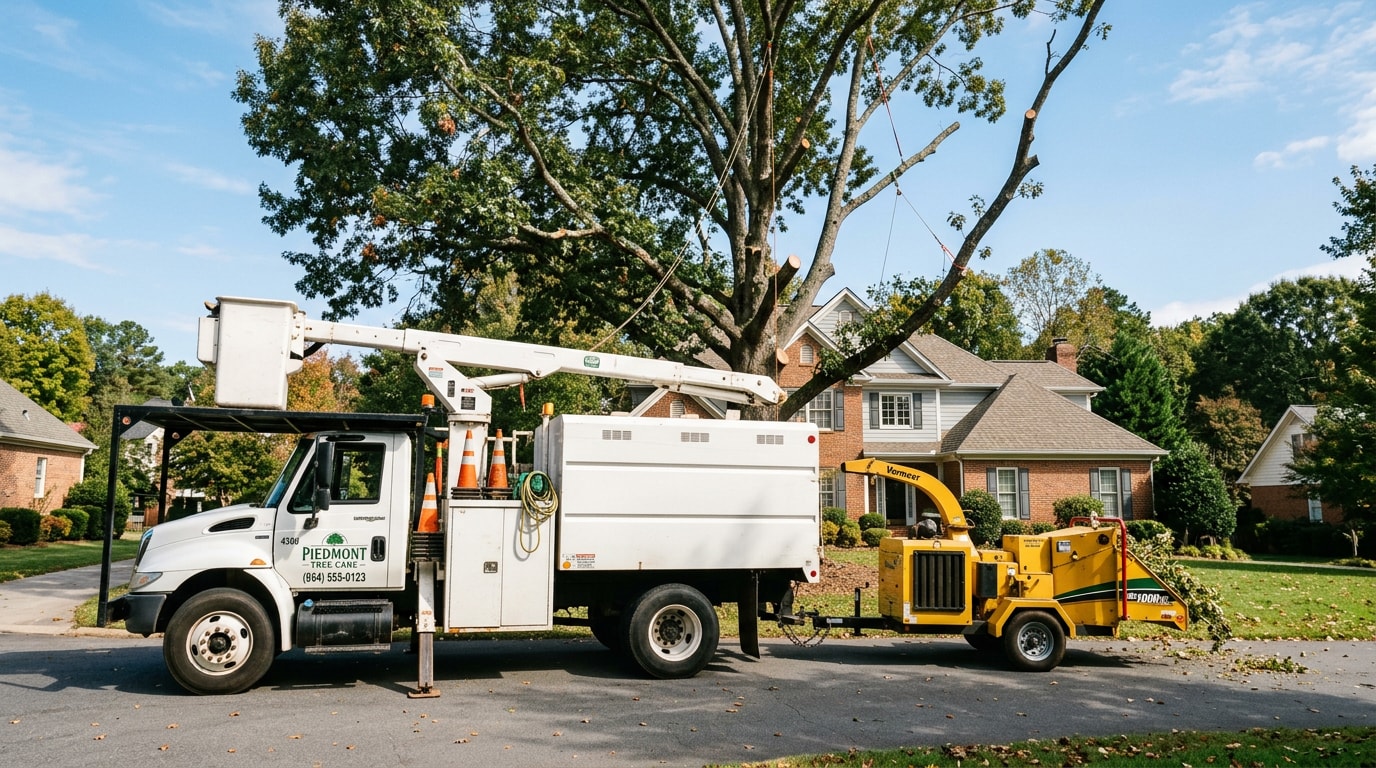

Tree crown reduction in Woodruff, SC trims back an oversized canopy without the drastic cuts that leave a tree weak for years afterward. Done correctly, it lowers storm risk, lets sunlight back into your yard, and keeps a mature oak or maple looking like a tree instead of a stump with sticks. Here's how the process actually works, what it costs, and how to spot a real reduction cut versus a hack job.
Why Crown Reduction Matters for Woodruff Properties
Overgrown canopies do more than block light. They strain weak branch unions, invite storm damage, and quietly chip away at curb appeal. Treating pruning as routine maintenance, instead of an emergency fix after a limb comes down, protects both the tree and your budget long-term.
Trees can contribute up to 15 percent of a property's value, which is one reason the South Carolina Forestry Commission considers proper tree care one of the best investments a homeowner can make. Left unpruned, overgrown or storm-stressed limbs become liabilities instead of assets. After years of pruning Upstate oaks, maples, and crepe myrtles across Spartanburg County, our crew at Green Canopy Tree Service has seen how one bad topping job can turn a healthy shade tree into a storm-risk removal within a few seasons.
If a leaning limb is already hanging over your roofline in Woodruff, don't wait for the next front to roll through. Request a free estimate before a minor pruning job turns into an emergency call.
Crown Reduction vs. Crown Thinning vs. Crown Raising
Not every overgrown tree needs the same fix. These four techniques cover almost every situation a Woodruff homeowner runs into, and knowing which one applies keeps you from paying for work you don't need.
| Technique | What It Does | Max Removal Per Season | Best For |
|---|---|---|---|
| Crown Reduction | Shortens height/spread via cuts to lateral branches | Roughly 25% of live crown | Trees outgrowing their space, storm prep |
| Crown Thinning | Removes select interior branches for airflow | Roughly 25% of live branches | Dense canopies, wind resistance |
| Crown Raising | Removes lower limbs for clearance | Varies by clearance need | Driveways, sidewalks, rooflines |
| Crown Cleaning | Removes dead, diseased, or weak branches | As needed, no cap on dead wood | Routine health maintenance |
Crown Reduction: The Core Service
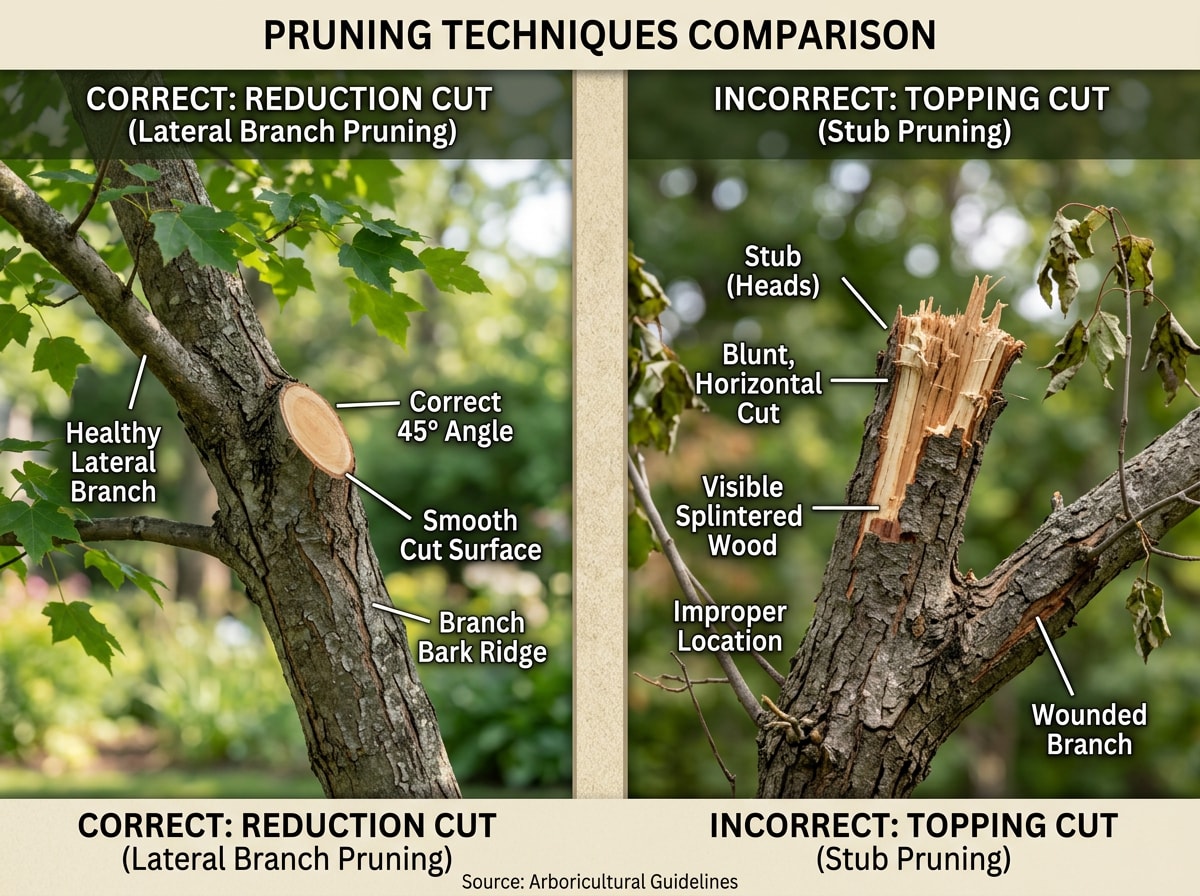
Crown reduction is a pruning technique that shortens a tree's height and spread by cutting back to healthy lateral branches, preserving its natural form. Unlike topping, which hacks limbs into indiscriminate stubs, reduction keeps the tree's structure intact.
Crown reduction pruning should be used only when necessary, and cuts should be made at a lateral branch that is at least one-third the diameter of the stem being removed. That one-third rule is the real technical line between a reduction cut and a topping cut, and it's worth asking any crew you hire whether they follow it.
Species matter here too. Upstate oaks and maples generally tolerate reduction well because they regenerate readily from older wood. Pines and other cone-shaped evergreens don't share that trait, which is why a reputable crew will usually recommend tree removal over repeated reduction cuts on a struggling pine.
Crown Thinning
Crown thinning selectively removes interior branches to improve light penetration and air circulation without changing the canopy's overall size. Thinning reduces wind damage by diminishing the degree of wind block , which matters when a Spartanburg County thunderstorm rolls through with a dense, top-heavy canopy already under stress.
As a general rule, no more than one-fourth of a tree's branches should be removed at one time. Crews that thin beyond that in a single visit are trading a healthy canopy for a quick-looking result.
Crown Raising / Lifting
Crown raising removes lower branches for clearance over driveways, sidewalks, rooflines, and sightlines. It's a practical fix for homeowners who need safe passage under a canopy or better visibility near a driveway entrance, and it pairs naturally with reduction or thinning during the same visit. See our full tree trimming services for how these techniques combine.
Health Maintenance Pruning (Crown Cleaning)
A sound maintenance program covers several goals in one visit:
- Selective thinning for airflow and reduced wind resistance
- Structural pruning for young trees still establishing their form
- Vista pruning to open a specific view without over-cutting
- Clearance pruning around buildings, rooflines, and utility lines
The best time to prune live limbs is during late winter or early spring , according to the South Carolina Forestry Commission. Flowering species and storm-damaged limbs are notable exceptions that can often be pruned sooner.
What We Check Before Recommending Reduction Over Removal
Not every tree that looks overgrown is a good reduction candidate. Before recommending reduction, our crew walks through a short checklist:
- Species tolerance — does this tree regenerate well from older wood, or is it better left alone?
- Decay and structural integrity — is there visible rot at the base or major limb unions?
- Live crown ratio — would reduction leave too little healthy canopy to recover?
- Clearance and risk — are the problem limbs close enough to a structure to need emergency tree removal instead of a scheduled visit?
If a tree fails that checklist, removal is usually the safer long-term call. We handle the full job from there, including dead tree removal, stump grinding, and hauling off the cuttings through our tree debris removal service so you're not stuck with a pile of brush in the yard.
What Does Crown Reduction Cost in Woodruff, SC?
Cost depends on tree height, species, and how hard the crew has to work to reach the canopy. Tall trees near power lines or structures cost more than smaller, easily accessible ones, and a site visit is the only way to get an accurate number for your specific tree. For a detailed breakdown of regional pricing factors, see our average cost to trim a tree guide, which covers the same Upstate market Woodruff sits in.
FAQ
Do I need a permit for tree removal in SC?
South Carolina has no statewide permit law, but Spartanburg County and local Woodruff ordinances may require permits for heavy pruning or removal near rights-of-way or protected trees. Check with your local planning office before major work near a property line.
What's the difference between tree trimming and pruning?
Trimming shapes a tree for appearance, while pruning is a technical practice that removes diseased, damaged, or hazardous limbs for the tree's long-term health and safety. The two often happen in the same visit.
What's the difference between crown reduction and topping?
Crown reduction uses precise cuts back to lateral branches to preserve structure, while topping hacks limbs into stubs at random points, triggering weak regrowth and decay. One is a controlled technique; the other is a shortcut that costs more to fix later.
How much of a tree's crown can be safely removed at once?
No more than one-fourth of the living crown should be removed at a time to avoid stressing the tree into producing weak, fast-growing sprouts. Trees needing more reduction than that should be staged over two or more seasons.
Is crown reduction bad for a tree?
Done correctly, no. Crown reduction performed with proper lateral cuts and within the one-fourth rule is a recognized, tree-safe technique. It only becomes harmful when a crew exceeds the safe removal percentage or makes heading cuts instead of reduction cuts.
How much does tree crown reduction cost?
Cost varies by tree height, species, and access difficulty. Tall or hard-to-reach trees near structures or power lines cost more than smaller, easily accessible ones, so a site visit gives the most accurate estimate.
What is the best time of year to prune trees in South Carolina?
Late winter through early spring, while most trees are dormant, is generally the best time to prune in South Carolina . Flowering species and storm-damaged limbs are notable exceptions worth pruning as soon as the damage is found.
Ready to get your canopy back under control before storm season peaks? Contact Green Canopy Tree Service for a free, no-pressure estimate on crown reduction in Woodruff, SC.